
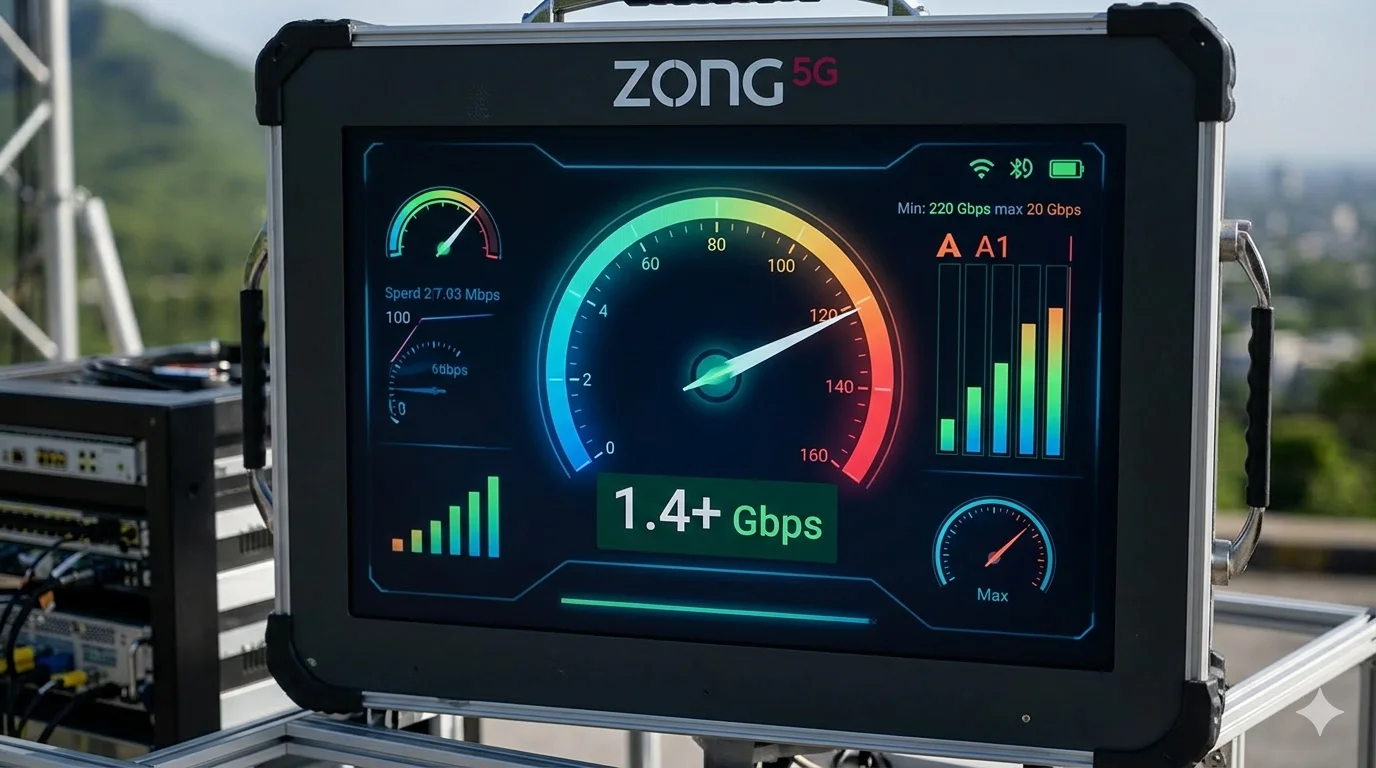
Zong 5G tests in Islamabad have officially clocked peak download speeds exceeding 1.4 Gbps, marking a critical milestone in the race for ultra-high-speed connectivity in Pakistan. The telecom giant confirmed that these pre-launch trials were conducted across diverse urban topologies, proving the network’s structural readiness for a commercial debut.
According to technical briefs, the operator achieved this 1,400 Mbps download speed by maximizing “output-to-spectrum” efficiency. This optimization ensures that Zong’s existing infrastructure can handle the massive data throughput required for next-generation mobile broadband without compromising stability.

Optimized Infrastructure Drives Zong 5G Tests
The success of the latest Zong 5G tests stems from a multi-year investment in AI-integrated traffic management. By using intelligent network self-management, the provider aims to maintain these blistering speeds even during peak congestion periods.
Zong’s journey toward the Pakistan 5G rollout has been defined by several industry firsts:
- 2019: Activation of the country’s first functional 5G node.
- 2020: Execution of South Asia’s inaugural 5G international video call.
- 2021–2025: Large-scale upgrades to core fiber backhaul and AI-driven optimization.
The Race for 5G Dominance
This announcement comes just days after Jazz reported similar trial results, signaling that Pakistan’s major players are in a dead heat. Zong’s strategy for the upcoming launch rests on three pillars: enhancing customer experience for 4G migrators, diversifying digital services, and utilizing AI to ensure the network remains “future-proof.”
As the Pakistan Telecommunication Authority (PTA) continues to finalize the spectrum auction framework, Zong’s successful trials in the capital suggest that the hardware is ready to go live the moment the regulatory green light is given.