
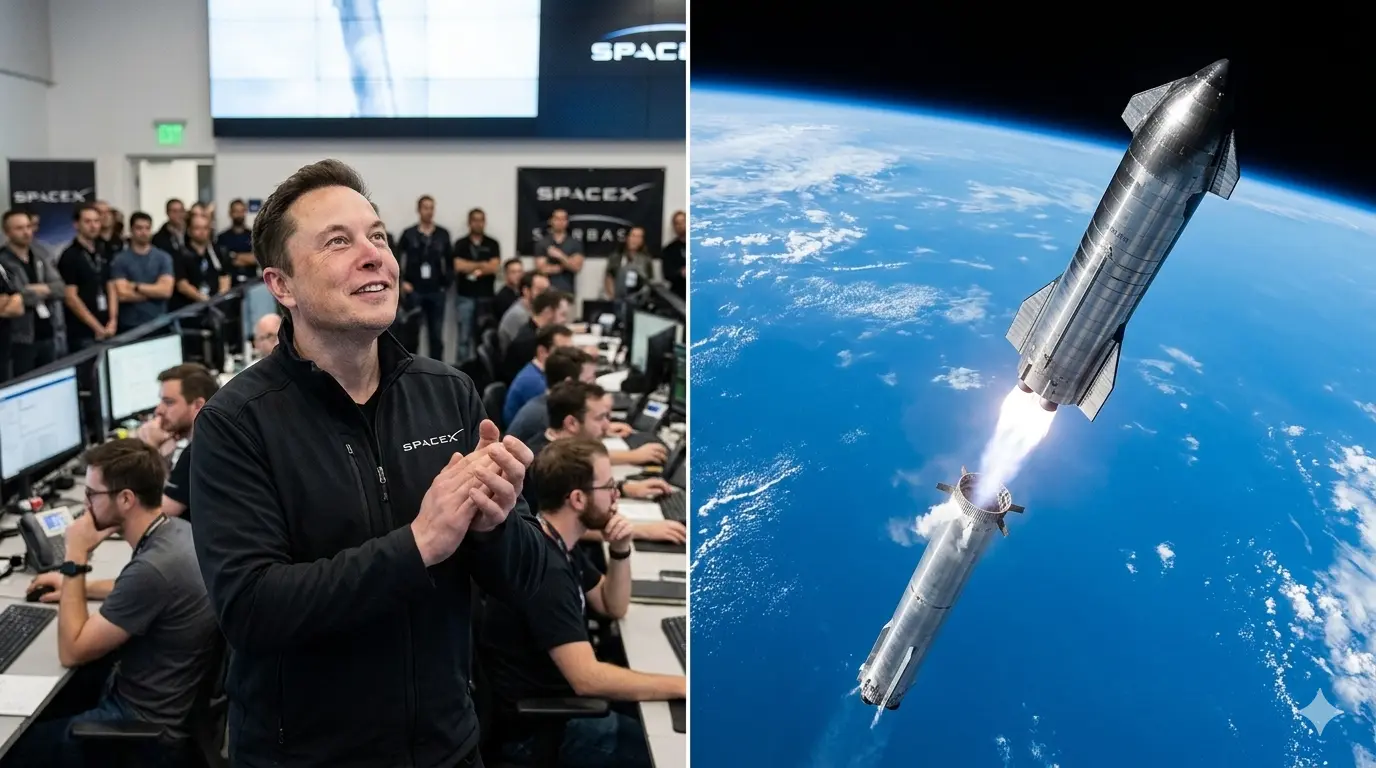
The SpaceX Starship orbital mission achieved total success today, marking the first time the world’s most powerful launch vehicle has completed a full flight profile from liftoff to controlled reentry. This milestone represents a definitive shift in space exploration, proving that a fully reusable, heavy-lift architecture is no longer theoretical but operational.
Why the SpaceX Starship orbital mission Changes Everything
The flight, which launched from the Starbase facility in Boca Chica, Texas, saw the 120-meter-tall vehicle clear the tower under the power of all 33 Raptor engines. Unlike previous tests, today’s mission saw a flawless “hot-staging” separation, sending the Starship upper stage into a stable orbit while the Super Heavy booster performed a pinpoint splashdown in the Gulf of Mexico.
Follow us for More:
Key achievements of today’s flight include:
- Successful Orbital Insertion: The upper stage reached its targeted velocity and altitude for the first time.
- Heat Shield Integrity: Preliminary data shows the hexagonal ceramic tiles withstood the 3,000°F plasma during atmospheric reentry.
- Payload Door Functionality: A critical test for future Starlink deployments and satellite launches was successfully executed in vacuum.

The Path to Mars and the Moon
This victory is a massive win for Elon Musk, whose vision of a multi-planetary human species hinges entirely on this platform. With the SpaceX Starship orbital mission now validated, the timeline for NASA’s Artemis III mission—intended to return humans to the lunar surface—looks more secure than ever.
As the craft successfully navigated the “max-q” stress points and the searing heat of descent, it silenced critics who doubted the stainless-steel design. For Mars exploration, this success means the cost per ton to orbit is expected to plummet, making long-term colonization a logistical possibility within the decade.
For official mission telemetry and live replay, visit SpaceX or check the latest NASA Artemis updates.